Installations
How Does Dynamic LED Lighting for Nightclubs Work?
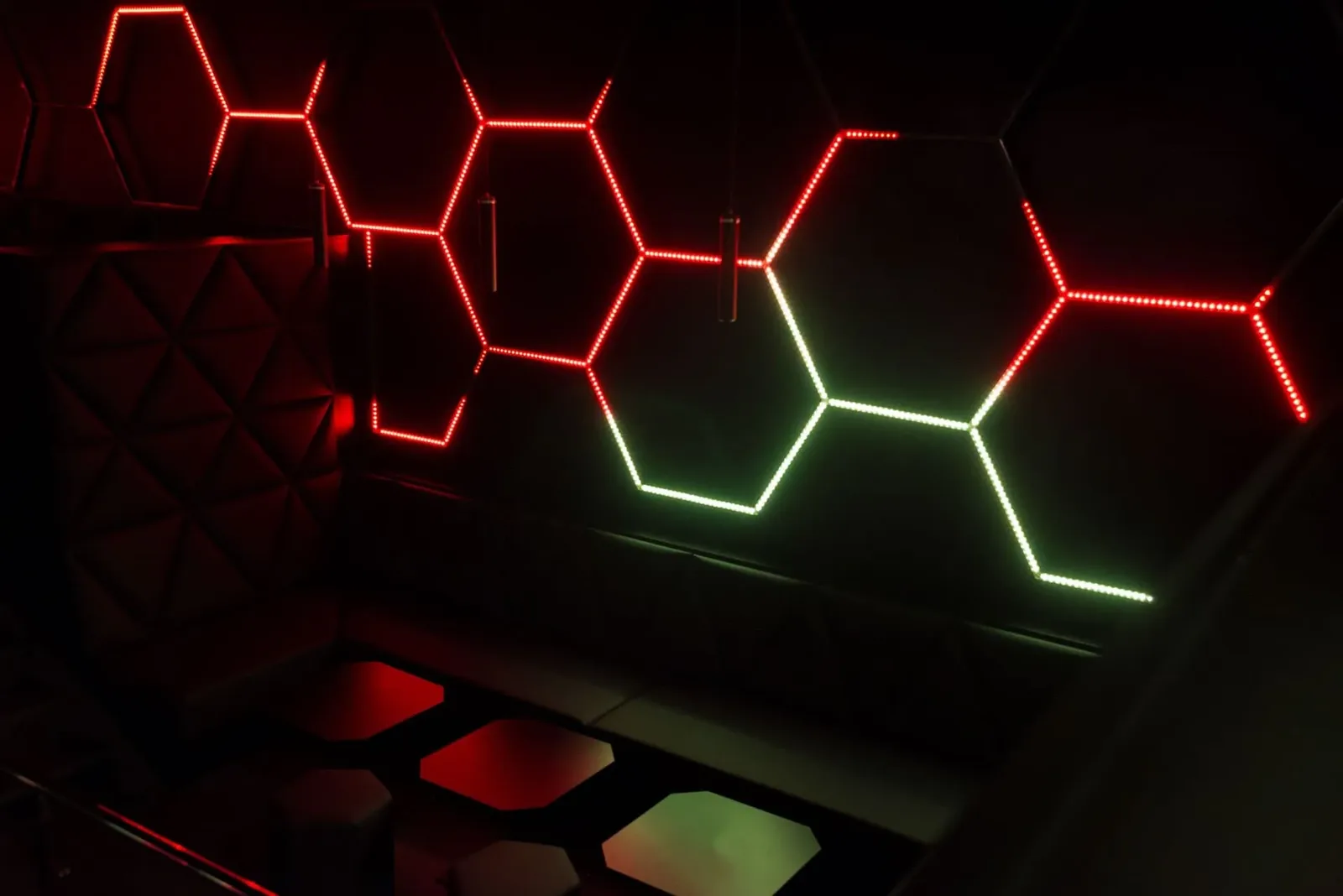
Most club interiors are still lit the way an office is lit: one scene, switched on at opening and off at closing. Dynamic LED lighting for nightclubs works differently — the light changes through the night and becomes part of the experience guests remember.
This article explains what such an installation consists of, how a project runs, and where these builds go wrong. It’s written for two readers: the venue owner deciding whether it’s worth it, and the integrator who has to make it work.
What Is Dynamic LED Lighting for Nightclubs?
Dynamic LED lighting is an installation in which every LED — or every small group of LEDs — can be addressed and changed independently over time. That single property is what separates it from conventional dimmed or color-changed lighting. Instead of one static color across a whole strip, you get movement, gradients, and choreography that runs along the architecture of the room.
The technical term for this is addressable pixel LED. Each pixel carries its own value, a controller feeds those values from a network signal, and software decides what the values should be at any given moment. The light stops being infrastructure and becomes content that can be rewritten without touching a single fixture.
For a venue, the practical consequence matters more than the terminology. One physical installation can deliver a calm entrance scene early in the evening, a warm lounge look at midnight, and a fast reactive show later in the night. No rewiring, no extra hardware.
Which Components Does a Club Installation Need?
Every dynamic installation is built from four layers: the light source, the mechanical carrier, the controller, and the software. Skip or underspecify any one of them and the whole system underperforms. One recent build used custom aluminum profiles and LED rods, a LEC3 Ethernet controller, and LED Strip Studio software driving the choreography.
What Does the LED Ethernet Controller 3 Do?
The controller is the translator between the network and the LEDs. It receives the show data over Ethernet and converts it into the serial protocol the pixel strips or rods actually understand. Everything downstream of it — refresh rate, color depth, how many pixels one run can carry — is defined by the controller’s capability, not by the strip. LEC3 itself drives up to 4096 RGB or 3072 RGBW pixels across 4 independent SPI outputs.
Why Does Software Matter More Than the Fixture?
Two venues can install identical hardware and get completely different results, because the mapping and the content decide what people see. Pixel mapping software tells the system where each physical pixel sits in real space, so an effect can travel across the room rather than just along a cable. Without a correct map, a wave effect becomes visual noise.
This is also where the operating cost lives. A venue that can recall and edit scenes itself — via the LSS Remote app or a saved scene list — doesn’t need to call an integrator for every seasonal change.
Case Study: A Custom Club Build in Bratislava
One of the more demanding projects our team has taken on was a club interior where light wasn’t just technology — it was a tool of emotion, perception, and atmosphere. The brief meant the lighting had to support the mood of the room without ever dominating it. The build used custom aluminum profiles with LED rods, driven by a LEC3 Ethernet controller and programmed in LED Strip Studio.
How Long Does a Project Like This Take?
Planning took several months of testing and design work. Installation and commissioning took a few intense days of fine-tuning, adjustments, and trial runs on site. That ratio is typical and worth stating plainly to any venue owner: the design phase is the long one, and the visible construction phase is short.
The result was a lighting scene that breathes with the nightlife — the space came alive visually and emotionally. Quieter venues such as galleries, museums and cinemas need the opposite approach, described in our guide to pixel LED lighting for public spaces.
How Do You Plan a Club Lighting Project?
A dynamic install fails or succeeds during planning, not during installation. The sequence below is the one we follow, and each step exists because skipping it costs money later.
- Site survey. Measure the room, note sightlines, seating, mirrors, and reflective surfaces.
- Define the scenes first. Decide what the room should look like at each part of the night before choosing any product.
- Select carrier and light source. Match profile type to the surface — aluminum profiles protect the LEDs and control the beam.
- Size the power and data runs. Power injection points and data run lengths are calculated here, not improvised on site.
- Map and program. Build the pixel map in LED Strip Studio 4, then create and name the scenes.
- Trial runs. Run the system under real conditions — full room, real staff, real music.
- Hand over. Train the staff who will operate it nightly.
Static vs. Dynamic Lighting: What Actually Changes?
| Criterion | Static LED lighting | Dynamic pixel LED lighting |
|---|---|---|
| Control per LED | No — whole strip acts as one | Yes — each pixel addressed separately |
| Scene changes | Manual, usually dimming only | Programmed, time- or trigger-based |
| Content updates | Requires physical change | Software update, no rewiring |
| Design phase effort | Low | High — mapping and scene design required |
| Operator skill needed | None | Basic software training |
| Guest-facing impact | Constant | Changes through the night |
Which Mistakes Ruin a Club Lighting Install?
The failures we get called in to fix repeat with remarkable consistency. Almost none of them are caused by faulty hardware.
- Buying hardware before defining the scenes. The product list should be an output of the design, never the starting point.
- Ignoring the pixel map. Unmapped installations can only run simple linear effects, which wastes most of the investment.
- Underestimating power distribution. Long runs without correct injection produce color shift and dim ends.
- Designing for photos, not for guests. A scene that looks striking on camera can be uncomfortable to sit under for four hours.
- No handover training. If staff can’t recall a scene, the venue defaults to one look forever.
Planning a venue and want to know what’s realistic in your space? Book a free consultation with our team.
Summary
In a dynamic pixel LED installation, every pixel is individually addressable, so one build can deliver many different scenes through the night. A working system needs four layers: light source, mechanical carrier, controller, and mapping software. One recent build used custom aluminum profiles and LED rods with a LEC3 Ethernet controller and LED Strip Studio software. Expect months of design and testing, then only days of on-site installation. Most failed installs are planning failures — no scene definition, no pixel map, or no staff handover.