Installations
How Was CNN Prima NEWS TV Studio LED Lighting Built?

A news studio is lit for an audience that never blinks: the camera. Every colour shift, reflection and uneven segment shows up on screen, often for many hours a day. This case study covers the TV studio LED lighting of CNN Prima NEWS in Prague: 1.5 km of pixel LED strips, 25 controllers and a 170 m² LED horizon.
It is written for broadcast engineers, set designers and integrators who plan large pixel installations in TV studios. It gives real numbers for control, network load and power start-up — where studio projects of this size usually run into trouble.
What Makes TV Studio LED Lighting Different?
TV studio LED lighting is scenic lighting built into the set itself, designed to look right on camera rather than to the naked eye. It is separate from the key and fill lights that light the presenters. In a modern news set, it usually combines addressable pixel LED strips in the set pieces with LED screens behind the presenters.
Three demands set it apart from venue or retail lighting. The camera exaggerates reflections and uneven brightness. The set runs through long broadcast days with no chance to fix a fault on air. And the creative team expects to change colours and moods between programmes without touching the hardware.
Addressable strips meet the last demand because every LED holds its own colour. A pixel LED controller turns data from a computer into those per-LED colours, so the whole set can be restyled in software.
What Are the Key Figures of the CNN Prima NEWS Studio?
CNN Prima NEWS is the Czech news channel run by FTV Prima under a CNN brand licence. It went on air on 3 May 2020 from a new broadcast centre in Prague. The figures below come from our project records and public sources; values marked as calculated are derived by us.
| Parameter | Value |
|---|---|
| Channel | CNN Prima NEWS (FTV Prima), Prague, Czech Republic |
| Set design | Jaroslav Holota, Ungroup |
| Studio type | Two-level (“double-decker”) news studio, more than 8 m high |
| Studio floor area | approx. 300 m² (public sources) |
| Pixel LED strips | approx. 1.4–1.5 km, 60 LEDs/m |
| Individually addressable RGB pixels | approx. 84,000 |
| Pixel controllers | 25 × LED Ethernet Controller 3 PRO (LEC3), 4,096-pixel version |
| Controller capacity in total | 102,400 pixels, about 82 % used (calculated) |
| Diffuser | Black plexiglass |
| LED horizon | More than 170 m² of P10 LED screen panels |
| Power supplies | 500+, fan-less, 150 W each |
| Power start-up | AC delay devices, 1–25 s delay per supply |
| Control computer | 1 × laptop with Intel Core i5 |
| Control protocol | LED Strip Studio network protocol (not Art-Net) |
| Preparation / installation | 1 year / 3 months |
Each LEC3 drives on average 3,360 pixels (calculated). That leaves roughly 18 % spare controller capacity for later changes to the set.
Why Does a Black Diffuser Need Double LED Strips?
The creative director wanted the most beautiful colours possible and chose black plexiglass as the diffuser. On camera it gives deep colour, high contrast and very low reflections from the set surfaces.
The price is brightness. A dark diffuser absorbs a large share of the light, so one strip per segment was not enough. We installed two LED strips in every light segment, which doubles the LED count and the power demand of each segment.

Case Study: How Was the Double-Decker Studio Built?
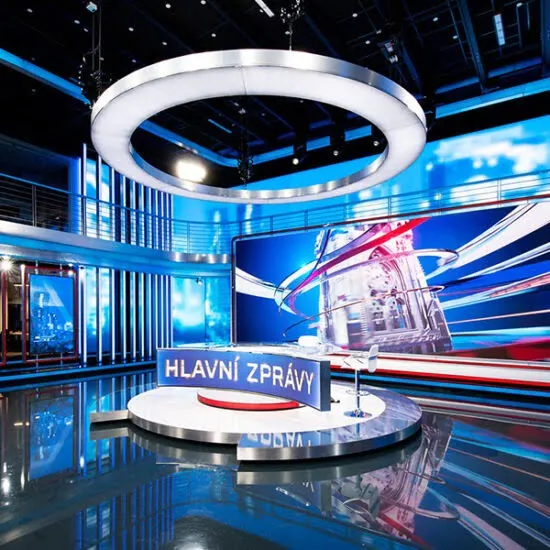
The studio is a “double-decker”: two levels in one space, with the upper floor used for live broadcasts and guests. At more than 8 metres high, it offers a lot of vertical surface for light. Architect Jaroslav Holota of Ungroup designed it as a space full of light, with many options for the production team.
LED Strip Studio lit the set with pixel LED strips and built the LED screen horizon, including its supporting structure and power start-up system. The project took one year of preparation and three months of installation. By the team’s own count, it also took more than 1,000 cans of Red Bull.
 Source: LED Strip Studio
Our rule of thumb is one hour of work per metre of strip, as explained in what a pixel LED installation really costs. For this set, that puts the strip work alone at around 1,500 man-hours (estimate). It remains the largest TV installation we have worked on. How news rooms, game shows and talk shows differ is covered in our guide to pixel LED for TV studios. More broadcast and venue builds are in our project portfolio.
How Was the P10 LED Horizon Fitted Pixel to Pixel?
For the horizon behind the presenters, we used standard P10 LED screen panels covering more than 170 m². P10 means a 10 mm pixel pitch, or about 10,000 pixels per square metre. Across the whole horizon, that is roughly 1.7 million pixels (calculated).
Panels only read as one screen when the joints disappear on camera. We built a custom aluminium structure so the panels sit precisely pixel to pixel, without visible seams or steps. The same structure carries the power supplies, which keeps cable runs short behind the screen.
 Source: LED Strip Studio
How Do 500 Power Supplies Start Without a Shutdown?
The LED system runs on more than 500 fan-less 150 W power supplies. Switching them all on at once is the problem. Every switch-mode supply draws a short current spike at power-up, called inrush current, far above its rated current. Multiply that by 500, and the peak can shut down the studio’s entire power generator.
We solved it with a device we developed for this project: the AC delay. It sits in front of each supply and delays its power-up by 1 to 25 seconds, set with pins on the device. Spread evenly, that is about 20 supplies switching on per second instead of 500 at once (calculated). The video below shows the device delaying the start-up.
 Source: LED Strip Studio

How Do You Control 84,000 Pixels From One Laptop?
All 84,000 pixels run from one ordinary laptop with an Intel Core i5 processor. The 25 LEC3 controllers are connected over Ethernet, and each drives its strips through SPI outputs. The scenes run from our pixel mapping software on the laptop, and multiple controllers stay synchronised over Ethernet.
The key is the protocol. We do not use Art-Net for installations with more than 10,000 LEDs. Our own LED Strip Studio protocol typically needs only about 20 % of the bandwidth Art-Net would need for the same pixels.
| Calculation for 84,000 RGB pixels at 40 fps | Art-Net | LED Strip Studio protocol |
|---|---|---|
| Colour channels | 252,000 | 252,000 |
| Universes needed (170 pixels each) | 495 | not applicable |
| Universes per LEC3 (3,360 pixels on average) | approx. 20 | not applicable |
| Packets per second | 19,800 | — |
| Network load, approx. | 91 Mbit/s | 18 Mbit/s (20 % of Art-Net) |
| Share of a 100 Mbit/s link | approx. 91 % | approx. 18 % |
All values in this table are calculated. The Art-Net load assumes 576 bytes per packet on the wire and a frame rate of 40 fps.
Why Not Use Art-Net Above 10,000 Pixels?
Art-Net carries DMX data over Ethernet in universes of 512 channels, which is 170 RGB pixels. At 84,000 pixels, that means almost 500 universes, each sent as a separate packet dozens of times per second. The laptop, switches and controllers must handle that stream without a break.
At this scale the data stream, not the LEDs, becomes the bottleneck. Cutting it to about a fifth leaves headroom for smooth playback on a standard computer and standard network hardware. Our guide to controlling LED strips over DMX and Art-Net explains the universe arithmetic in detail.
 Source: LED Strip Studio
Which Mistakes Should TV Studio LED Projects Avoid?
Large pixel sets fail for predictable reasons, mostly decided long before the first broadcast.
- Choosing the diffuser after the strip. A dark diffuser can require double strips and double power. Test it on camera before ordering.
- Switching on hundreds of power supplies at once. Inrush current can shut down the studio supply. Stagger the start-up with delay devices.
- Sending 80,000+ pixels over Art-Net by default. Calculate the network load first; a leaner pixel protocol can cut it to a fraction.
- Ignoring LED panel alignment. Without a precise structure, every panel seam shows on camera.
- Underestimating preparation. This studio needed a year of preparation for three months on site.
Planning pixel LED lighting for a TV studio? Book a free consultation and we will size the controllers, network and power with you.
Summary
The CNN Prima NEWS studio in Prague is a two-level news set lit with about 84,000 addressable RGB pixels on roughly 1.5 km of LED strip, driven by 25 LEC3 controllers from a single Intel Core i5 laptop. Our own network protocol needs about a fifth of the bandwidth Art-Net would for the same pixels. A black plexiglass diffuser gives deep colour on camera but required two strips per segment, a custom aluminium structure fits more than 170 m² of P10 LED panels pixel to pixel, and AC delay devices start more than 500 power supplies over 1–25 seconds so inrush current cannot shut down the studio's power.